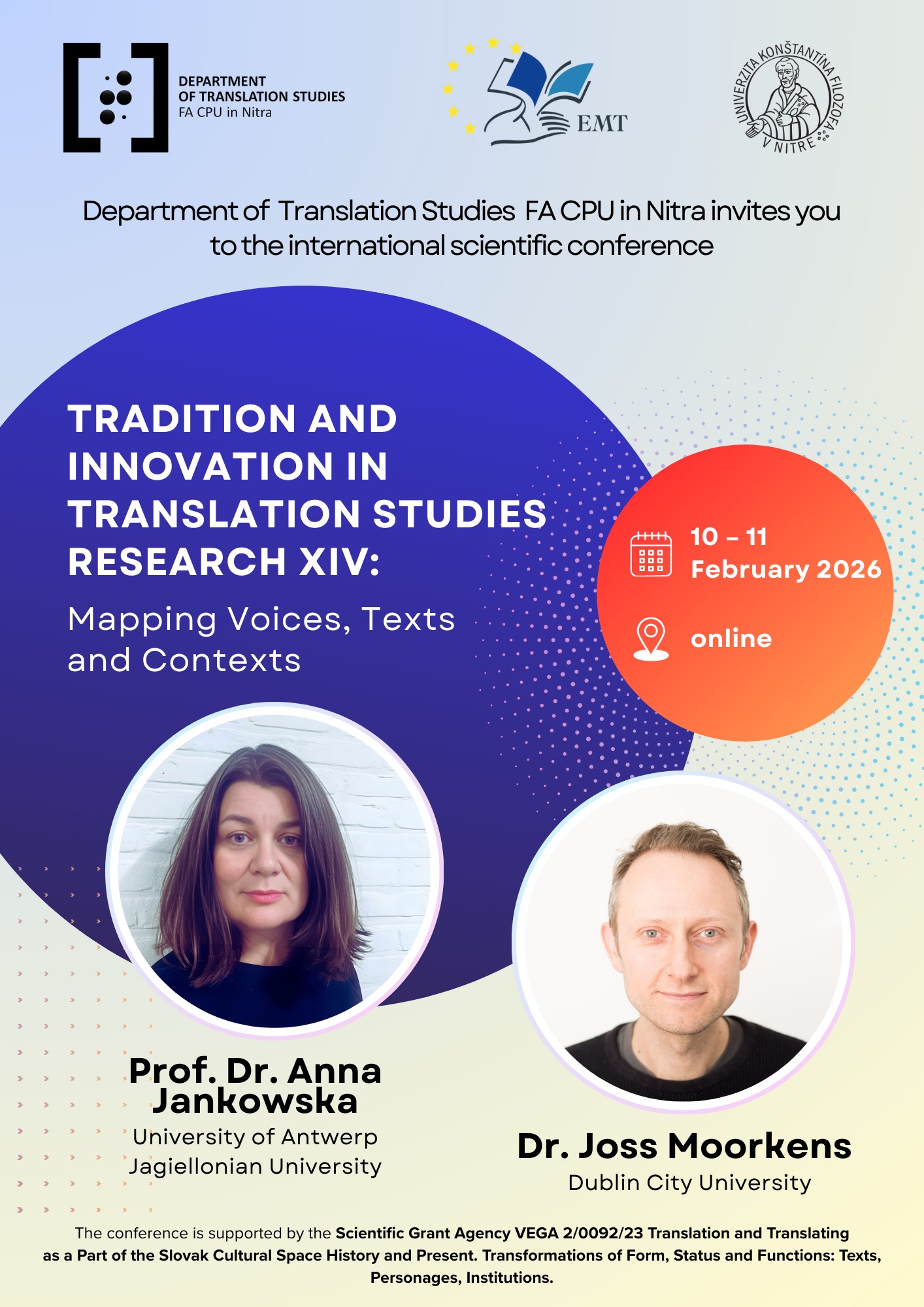
Fourteenth Annual Conference Tradition and Innovation in Translation Studies Research
On February 10–11, 2026, the Department of Translation Studies hosted the 14th annual international scientific conference Tradition and Innovation in Translation Studies under the subtitle Mapping Voices, Texts, and Contexts. This year’s edition of the conference, intended for doctoral students and young researchers, reflected a number of research directions within translation studies, from the study of various actors in the translation process or interpreting, through the analysis of textual material, to the broader social, cultural, political, and technological frameworks in which these activities take place.
The opening of the conference was honored by the presence and address from the Dean of the Faculty of Philosophy, Prof. PhDr. Martin Hetényi, PhD., the Head of the Department of Translation Studies, Doc. Mgr. Soňa Hodáková, PhD., and the scientific guarantor of the conference, Doc. Mgr. Emília Perez, PhD. On behalf of the organizing team consisting of internal doctoral students of the Department of Translation Studies, Mgr. Lívia Kodajová, Mgr. Kristína Sadloňová, Mgr. Radoslava Juhásová, Mgr. Romana Chantal Čuláková, and Mgr. Romana Jurigová, one of the organizers, Mgr. Lívia Kodajová, gave the opening speech and introduced the main speakers.
The conference was held online, and nearly thirty doctoral students and young researchers from around the world presented their research at the online conference, delivering enriching contributions on various topics within the field of translation studies. The participants’ contributions offered a wide range of theoretical and empirical perspectives on current research in translation studies and stimulated discussion on new challenges within the field. The two-day programme was divided into five thematic sections: New Challenges in Audiovisual Translation, Sociocultural Aspects in Translation Studies, Artificial Intelligence in Translation Studies, Translation Didactics and Methodology, and Interpreting, Politics, and the Public Sector. After each section, the audience and participants had the opportunity to engage professional discussions and exchange mutual feedback.
The programme for both days also included presentations by keynote speakers, who introduced current research topics of international relevance in their plenary lectures. Their contributions enriched the conference programme with inspiring insights, also from an interdisciplinary perspective. Two keynote speakers accepted the organizers’ invitation: Professor Anna Jankowska from the University of Antwerp in Belgium and Jagiellonian University in Poland, whose lecture on the topic Accessibility as an Open Question presented accessibility as an issue from a broader perspective beyond the scope of translation studies, and Professor Joss Moorkens from Dublin City University in Ireland, who presented his research conducted within international cooperation by an Irish-Thai team of scientists focused on Migrant workers’ MT literacy: Field work with Myanmar workers in Thailand, illustrating the social impact and challenges associated with the use of translation technologies in the context of languages of lesser diffusion.
Master’s students in Translation and Interpreting at the Department of Translation Studies also had the opportunity to work as part of an interpreting team, providing remote conference interpreting either from home or from the interpreting booths in the department’s laboratory. This hands-on experience in a real remote interpreting setting enabled them to further develop their professional competences and to integrate the theoretical knowledge and practical skills acquired in seminars with authentic interpreting practice.
The conference was supported by the project VEGA 2/0092/23 Translation and Interpreting in the History and Present of the Slovak Cultural Space. Transformations of Forms, Status, and Functions: Texts, Personalities, Institutions. Like its previous editions, the fourteenth annual conference Tradition and Innovation in Translation Studies reaffirmed its position as a stable platform for sharing knowledge and presenting the latest research findings, fostering and sustaining international collaboration, and supporting the next generation of emerging scholars in the field of translation studies.
Gallery